
Published by Podium Body Works · Drawn from owner Tracy Haywood’s claims-desk experience · Last updated July 2026
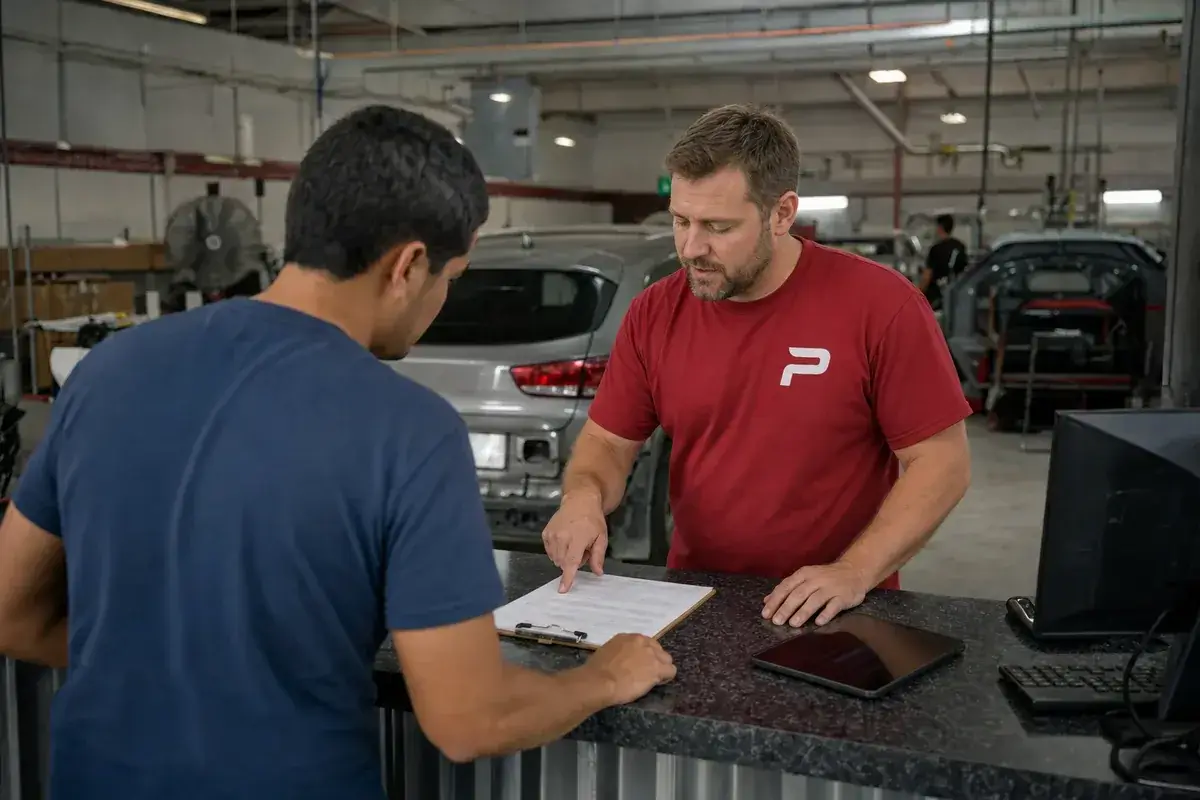
Yes, by law. The Texas Insurance Code is explicit that an insurer may not require you to use a particular repair shop. Your insurer can recommend a network shop; they cannot force one on you, delay your claim for refusing, or threaten your coverage over it. Here’s the honest context from the shop side: network shops answer to the program that feeds them cars. An independent answers to you.
When an adjuster says “we can’t guarantee the repair at that shop,” translate it: the shop guarantees the repair, ours with a limited lifetime warranty for as long as you own the vehicle.
Steering is pressure to move your repair into the insurer’s network, and Texas law draws the line clearly: an insurer may not limit your selection of a repair facility, and in a third-party claim may not require you to use a particular shop or particular parts. Recommending a network shop is legal. Requiring one, or penalizing you for declining, is not.
Across the counter, steering rarely sounds like an order. It sounds like “we can’t guarantee that shop’s work,” and shops guarantee repairs, not insurers, ours with the limited lifetime warranty. It sounds like “your claim may take longer there,” and the claim runs on documentation, which we handle daily. It sounds like “they’re not on our list,” and the list is the program, while the choice stays yours. If a line like that turns into an actual delay, the Texas Department of Insurance takes consumer complaints, and we’ll help you document what happened.
You file, we take it from there, and pickup day is the only other thing on your calendar. In practice: most customers arrive with a claim already filed; if you’re unsure whether the damage is even worth a claim against your deductible, we’ll write a free estimate first and tell you straight. From your claim number onward we handle the insurer, the documentation, the teardown, the approval, and the repair.
The Texas Department of Insurance publishes the consumer-side rules; what we add is the daily practice of making them work for you.
The damage the first estimate couldn’t see, found and documented after teardown. Adjusters write the first estimate from the outside of a wrecked car; we then take the damaged area fully apart and nearly every claim, in our experience effectively all of them, grows once the hidden damage behind bumpers, fenders, and doors is exposed.
We circle every finding with markers so the adjuster sees exactly what we see, we write the supplement, and we argue it if it needs arguing. You’ll hear from us that the estimate changed; you won’t have to do anything about it.
You do, if you’re the vehicle the claim is filed on, and you pay it at pickup. If someone hit you and their insurance is paying, you owe no deductible at all. We say this at drop-off, every time, because the pickup-day surprise is the industry’s worst habit. One exception worth knowing from hail season: when smashed glass has to be replaced immediately so you can keep driving while dent parts arrive, the deductible is collected at that first visit.
The insurer, not the shop, declares it, and then you have two choices: let them take the car at its value, or retain it at a reduced payout and repair it your way. If we can see a likely total on arrival, we say so upfront.
Otherwise it emerges at teardown, when the repair math crosses the threshold, and we call you before anything else happens. One quiet advantage of an owner-retained repair: an insurance repair must follow the estimate line by line, but on a retained car you choose what gets repaired and how, and we can build that plan with you, always to a standard that leaves the vehicle safe and legal to drive.
By math, not mystery. The insurer compares the cost of repairs to your car’s actual cash value, its market value the moment before the damage, and totals the car when repairs cost more than the car is worth. That is also where Texas draws its salvage line: a vehicle is salvage when repair costs exceed that value, with repainting and sales tax excluded from the count.
Two things follow from the math. First, actual cash value is negotiable: it rests on comparable vehicles, and if the insurer’s comparables are wrong, you can challenge them with better ones; the TDI consumer guidance linked above explains the process. Second, the math explains late totals: supplements grow the repair cost as hidden damage is documented, and a car that arrived repairable can cross the line at teardown. We tell you the moment the numbers turn, not at pickup.
They’re comprehensive claims, not collision claims, and hail is an act of nature, so filing one doesn’t rate you like an at-fault accident. Most hail deductibles vary by policy and often start around 250 dollars. The process difference is where the car should be: we want hail cars dropped off for the adjuster’s visit, about two hours, because our 360 degree light tunnel shows every dent and gets the approval right the first time.
Most hail cars stay drivable while parts and approval land; the full detail lives on our hail repair page.
Because the programs told us how to repair cars, and we disagreed. We spent years inside a direct repair program, and we left it: the program pushed cheaper parts, discouraged safety inspections and calibrations, and measured shops as numbers. Every repair here now runs on one standard, the manufacturer’s, for every customer, insured or not.
We still work with every insurance company, daily and professionally. We just don’t answer to any of them. The repair answers to you, and to the warranty we put our name on.
Send a few photos and we will get you a clear, honest estimate. Certified, insurer-independent, and accountable for the work.